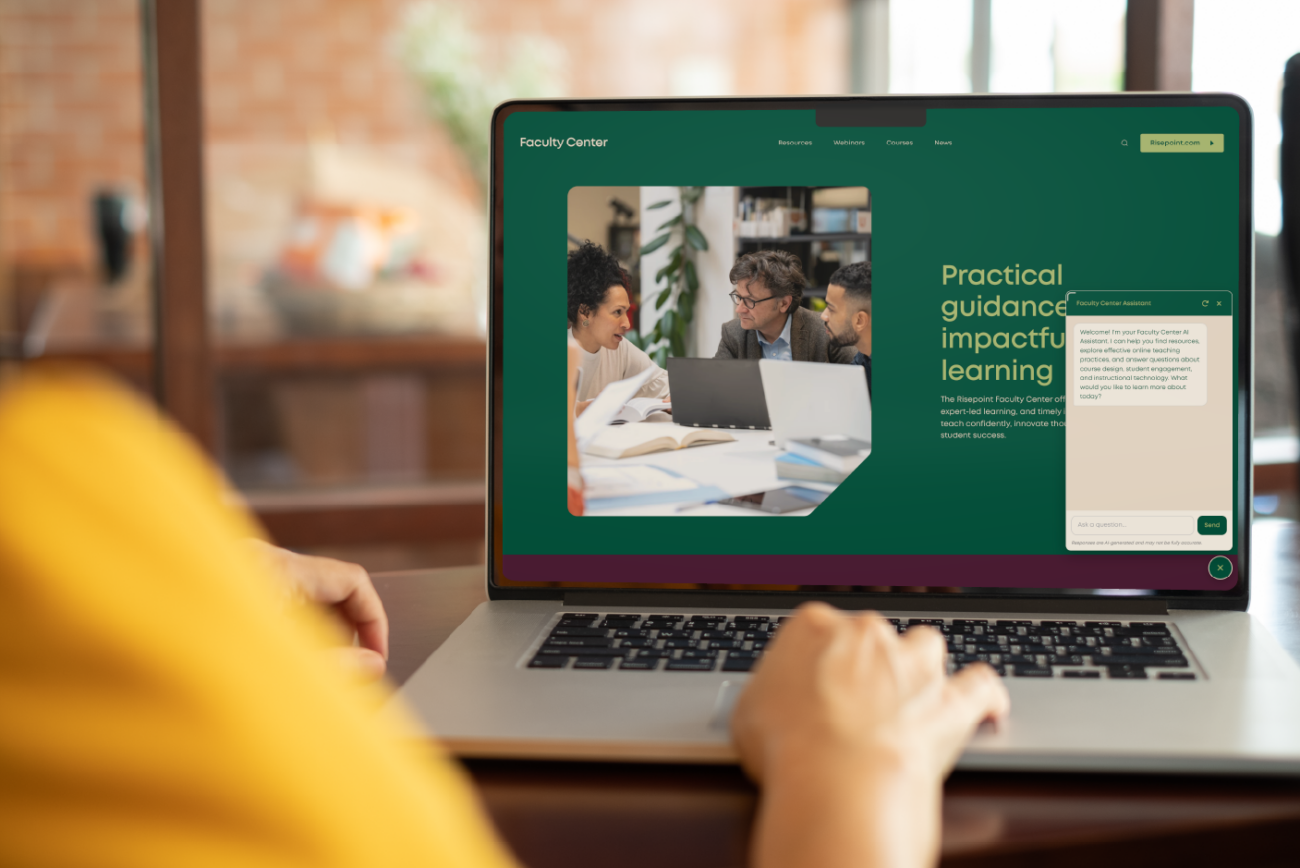
Every year, we survey students of online programs, and as AI has become mainstream, they have increasingly expressed interest in learning to use AI ethically and productively in their coursework and careers. Guiding faculty on how to incorporate AI into their curriculum – and how to use AI to strengthen their course development – has become an important part of how we support our university partners. In addition to working directly with faculty, our Academic Services team also produces the Faculty Center, a collection of resources for faculty to keep up to date with AI and online learning best practices. The Faculty Center includes a wealth of courses, webinars, examples, and news to inform how faculty at Risepoint partner institutions build and teach their courses.
The Academic Services team had already been leveraging AI for several years, so when Risepoint launched a chatbot to support our partners’ prospective students earlier this year, an idea emerged: why not create an AI assistant to support the faculty experience, too?
The team launched the AI assistant on the Faculty Center website in September. The AI assistant can help faculty find resources, explore effective online teaching practices, and answer questions about course design, student engagement, and instructional technology. Our own instructional design team also uses it to surface the right material from the many resources available on the Faculty Center. Instructional designers at Risepoint work closely with faculty to provide individualized guidance and share best practices for incorporating AI into their curriculum and using it to enhance their course development, but the AI assistant can extend that support outside of working hours. “If you’re working on your course late at night, you have help available to you to work through your problem with evidence-based practices,” said Torie Wynn, Director of Professional Learning and Development at Risepoint.
There are also intangible benefits of adding an AI assistant to the mix. “When you’re working with an instructional designer, you might feel shy asking questions, or you might not want to bother someone who you think is busy,” said Bill Cochran, Director of Academic Technology and Media at Risepoint. “One benefit of a bot is that it’s an always-on, judgment-free platform.”
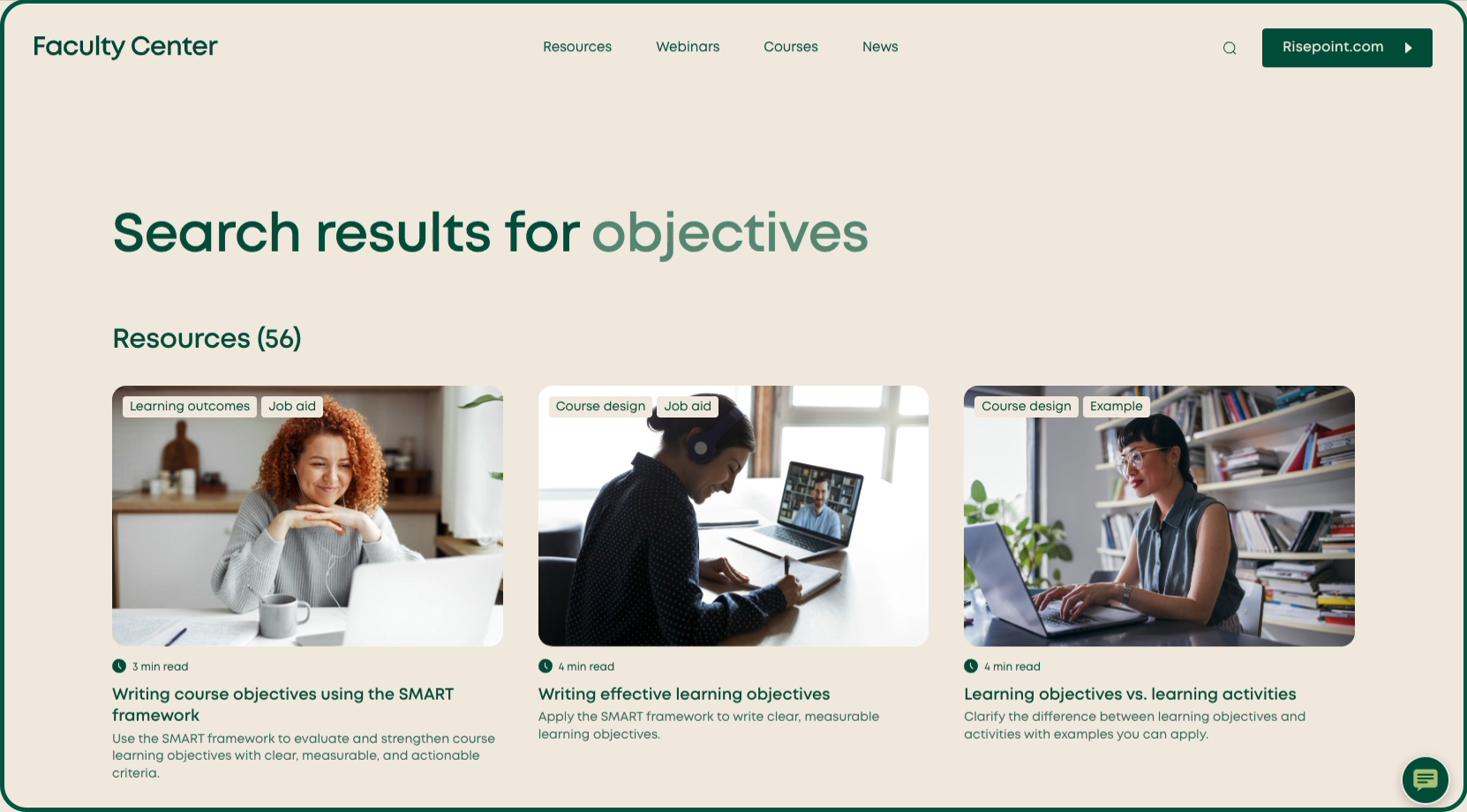
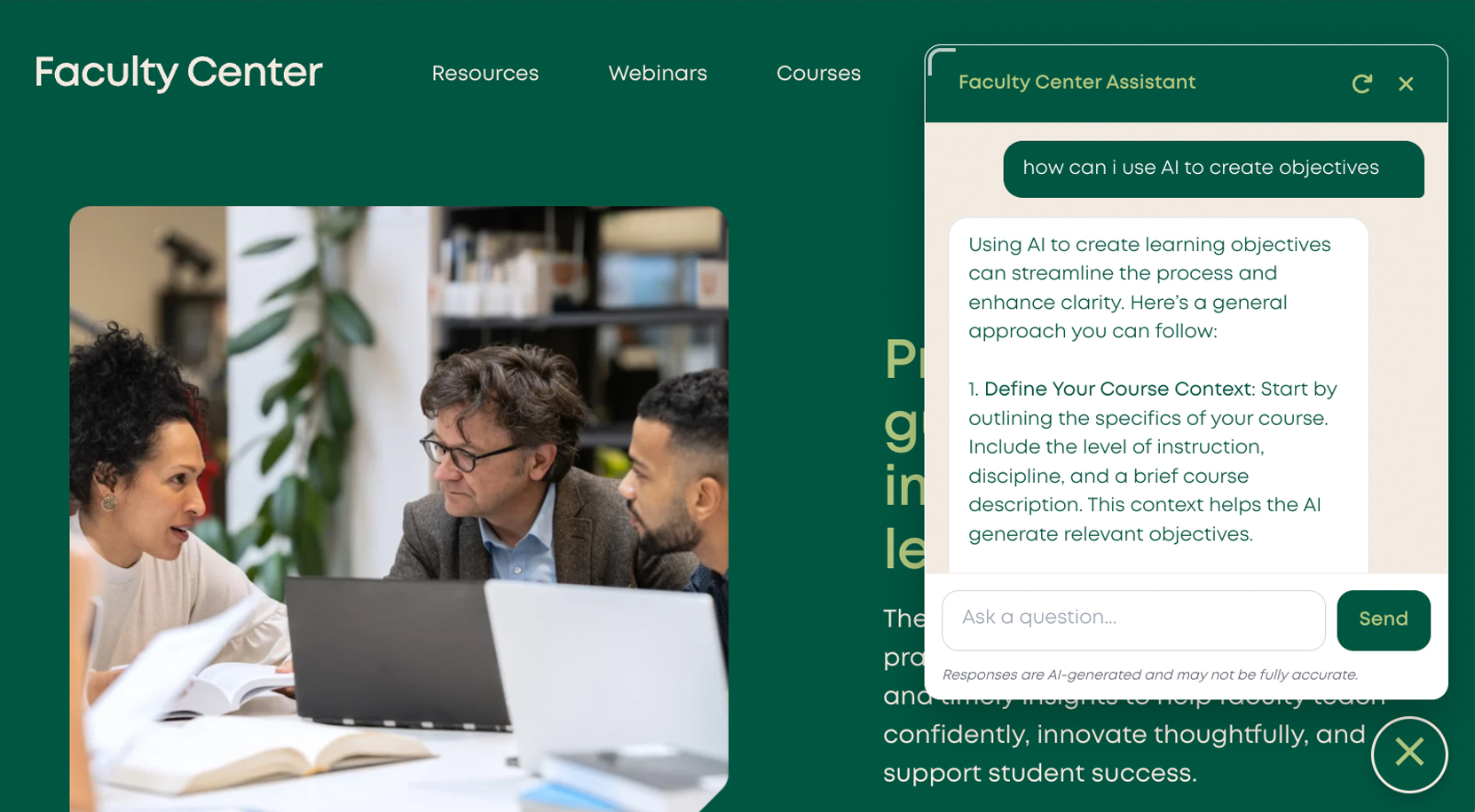
The AI assistant is also a more robust option than a search engine. For example, if a faculty member wanted to find resources on designing course objectives, a search tool would surface relevant articles, but the AI assistant can give actionable guidance drawn from those articles and then share additional resources.
Via search:
Via the AI assistant:
Two of the most important considerations for the team in building the AI assistant were making sure it captured the instructional designers’ expertise and reflected the thoughtfulness that goes into the relationship between Risepoint Academic Services staff and faculty at our partner institutions. Curriculum design sits squarely with faculty; Risepoint staff are here to offer expertise, but do not influence the curriculum. The first thing the team did was put all the content from the Faculty Center into a database, which became the sole source of knowledge for the AI assistant to draw upon. “We’ve done our very best to make sure it’s not pulling answers from general training that AI has. It’s not making things up on the spot,” said Connor Shepard, Senior Instructional Technologist and one of the developers on the project.
The next thing the team undertook was putting guardrails around what the AI assistant could answer for faculty and which topics it should avoid. “We needed to make sure any sort of AI would speak in the same way that our team would also do,” said Wynn. “We don’t do the work for faculty. We make recommendations; we explore best practices. It was about constructing guardrails to say, ‘I can’t build a rubric for you, but I can make recommendations and surface resources,’ so we’re enabling faculty to do the work instead of doing it for them.” Other guardrails directed people to the right resource if they asked a question that was out of scope; prohibited the bot from giving legal advice or grading student work; and protected against mental health concerns. The AI assistant was also trained to acknowledge when there isn’t an existing resource that can answer the user’s question.
“We don’t do the work for faculty. We make recommendations; we explore best practices.”
Torie Wynn, Director of Professional Learning and Development
Now that the AI assistant is live, the team is continuing to learn from how faculty engage with it. “We are using Google Analytics to dig deeper into what types of things people are asking of the AI assistant, taking that feedback, and updating the content we have,” said Ali Hrasok, Faculty and Systems Enablement Lead at Risepoint. In this way, the AI assistant works full circle, serving faculty with useful resources and guidance on their own schedule and providing another source of insight into the questions they have so that our teams can develop future content. As AI changes rapidly, our teams are here to help faculty stay up to date and develop courses that teach their students the latest AI skills, as well.