Insights from AASCU: How universities are evolving to deliver on online learner expectations
ByRisepoint Staff|
The future for state colleges and universities isn’t being driven by technology alone. It’s being shaped by culture, leadership, and a willingness to rethink long-held assumptions about how learning happens. Every president now faces the same challenge: evolving quickly enough to meet student needs and continuing to fulfill their institution’s core mission.
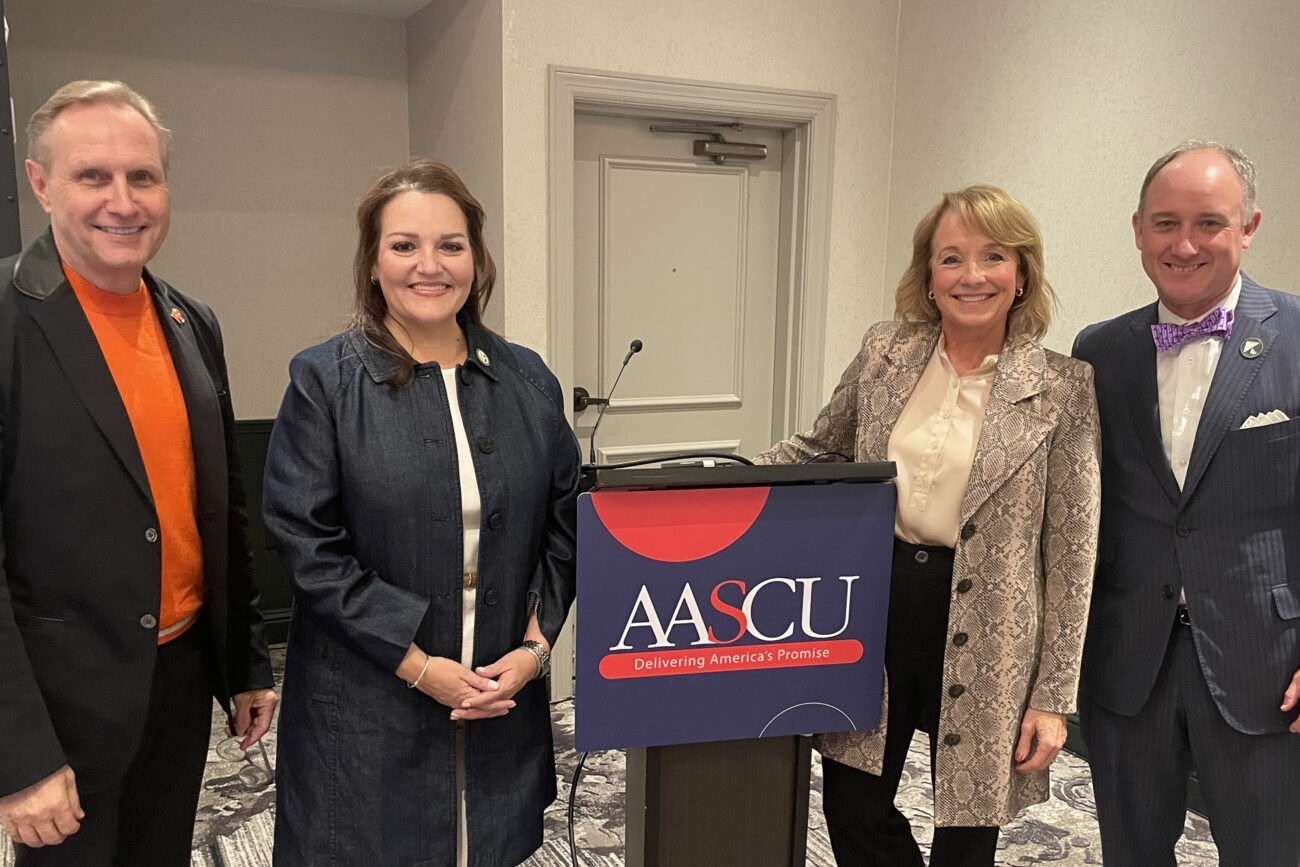
That evolution was the focus of a recent discussion at the American Association of State Colleges and Universities (AASCU) conference with insights on what modern students value most according to the 14th annual Voice of the Online Learner report. Dr. Donna Hodge of Fitchburg State University and Dr. Richard Helldobler of William Paterson University joined Susan Dukes, President of University Partnerships at Risepoint to share how their institutions are adapting in ways that strengthen, rather than shift from, their mission.
(L-R) Dr. Richard Helldobler, Dr. Donna Hodge, Susan Dukes, and Jay Hatcher
Their experiences challenge a common assumption: that growing online means pulling resources from what’s already working. Done with purpose and partnership, online programs can be a net gain: serving more working adults who need flexibility, career relevance, and a faster path forward.
Aligning programs to workforce demand
For both institutions, workforce alignment is about more than chasing trends. It starts with understanding regional needs and using data and employer feedback to shape programs that lead to real jobs.
Historically, universities have developed new courses through processes designed for stability rather than speed. Hodge explains how Fitchburg addresses this challenge: “The programs that we’re developing online mean that we can test pilot things and then start talking about scalability. And that is a much less scary approach.”
The programs that we’re developing online mean that we can test pilot things and then start talking about scalability. And that is a much less scary approach.
Dr. Donna Hodge, President at Fitchburg State University
Fitchburg has built partnerships with regional hospitals and municipalities to create degree pathways for public-sector employees. These programs are designed to meet workforce needs while giving learners a path to career advancement.
William Paterson uses a mix of labor-market forecasts, portfolio health checks, and market analysis to decide where to invest or refine. The university posts salary outcomes and employer placements by program, offering a transparent view of student results.
“Regional publics can’t be all things to all people,” said Helldobler. “The key is focusing on programs that meet workforce needs while staying true to mission.”
Rethinking how universities serve adult learners
Online learners are driven, but their lives are often complicated. The Voice of the Online Learner makes that clear: 87% work full or part-time, 53% have children under 18, and the average learner is 37. These responsibilities shape how they can learn and what they need from a university.
Flexibility can be the difference between a student finishing a degree and walking away.
At Fitchburg, that has meant shifting to a seven-week course model that lets students focus on two classes at a time. “If you have a life event during the first seven weeks, you lose six credits, not twelve,” Hodge explained. “That can make the difference between finishing and stopping out.
William Paterson focuses on removing barriers by offering credit for prior learning and academic forgiveness policies, helping returning adults rebuild momentum and financial aid eligibility. The university is exploring models for debt forgiveness, drawing on promising results from other regional institutions. The goal is simple: make it easier for students to come back, move forward, and finish strong.
For both leaders, flexibility is not just about convenience. It’s about creating policies, touchpoints, and structures that help students stay on track and feel part of the institution, whether they study from a campus classroom or a kitchen table.
That sense of belonging can show up in unexpected ways. “Our online students may never come to campus until commencement,” said Helldobler. “But when they do, they bring their families and their pride. It’s changed how our faculty see online learning.”
Evolving offerings to address emerging challenges
The 2025 Voice of the Online Learner report shows that 67% of students see Gen AI knowledge as essential for future workplace success. Both universities view this growing need not as a disruption but as an opportunity to strengthen their missions. As employers adapt to an AI-enabled economy, they’re looking for graduates who can use these tools thoughtfully and effectively. For regional universities, that demand opens new pathways to connect education and employability.
At Fitchburg State, that opportunity led to the creation of a new AI certificate program that attracts both graduate and undergraduate students. At William Paterson, faculty are piloting Blackboard Ultra’s AI tutoring tool, which draws only from course content. “We’d rather guide how students use AI than ignore it and let outside tools define the experience,” said Helldobler.
We’d rather guide how students use AI than ignore it and let outside tools define the experience.
Dr. Richard Helldobler, President at William Paterson University
Early action has also proven to be a competitive advantage. “If you’re not first to market, you don’t get to define the guardrails,” he added.
For both institutions, AI isn’t a headline or a side project. It’s a literacy that connects directly to workforce readiness. By integrating AI into coursework, they’re helping students stay relevant in a rapidly changing job market and giving faculty the tools to model the adaptability that defines lifelong learning.
Creating a culture that welcomes change
Both leaders agreed that technology is not the hard part of innovation: culture is. The challenge lies in fostering a shared sense that change is an evolution of mission, not a departure from it.
“Online can be additive,” said Hodge. “It gives us space to pilot ideas without spending the cultural capital we have with faculty.”
At Fitchburg, that approach has meant treating online programs as a low-risk research and development lab, a way to test shorter terms, try new delivery models, and build faculty confidence before scaling up. See how Fitchburg State scaled online learning with Risepoint.
Helldobler took a different path, choosing decisive action when the timing was right. Before the pandemic, William Paterson launched fully online MBA and RN-to-BSN programs despite skepticism. When enrollment surged and outcomes improved, that early commitment changed the campus conversation and created an environment where experimentation felt safe and valued.
Both presidents emphasized the importance of storytelling in driving change. Sharing early successes and student outcomes helps move even the most traditional faculty from concern to curiosity.
Planning for scale and sustainability
Growth brings new pressures on infrastructure, advising, and academic operations. Both presidents stressed the importance of planning for scale rather than reacting to it.
William Paterson ties hiring to enrollment thresholds, adding advisors and financial aid staff at specific points of growth. Faculty lines expand in the same way, starting with teaching-focused appointments that convert to tenure-track positions once demand stabilizes.
Fitchburg is integrating its online and graduate operations more closely with the broader campus to avoid duplication and maintain academic consistency. “Our goal is to make all of this future-proof,” Hodge said.
Leading with purpose and partnership
AASCU institutions sit at a unique point of influence. They are engines of mobility and regional growth, where mission and innovation meet. The experiences at Fitchburg State and William Paterson show how partnering with Risepoint to expand online learning can strengthen institutional identity and reach more of the students they were founded to serve.
When universities build cultures of adaptability, align programs to workforce needs, and design for adult learners, they create new ways to deliver on the public good.
Our experienced team is just a click away to answer any questions, respond to requests for RFP submissions, or even help with a complimentary market assessment. Tell us how we can help and a member of our team will be in touch.